


Weak Payrolls Could Block a September Fed Hike, Bloomberg's Wong Says
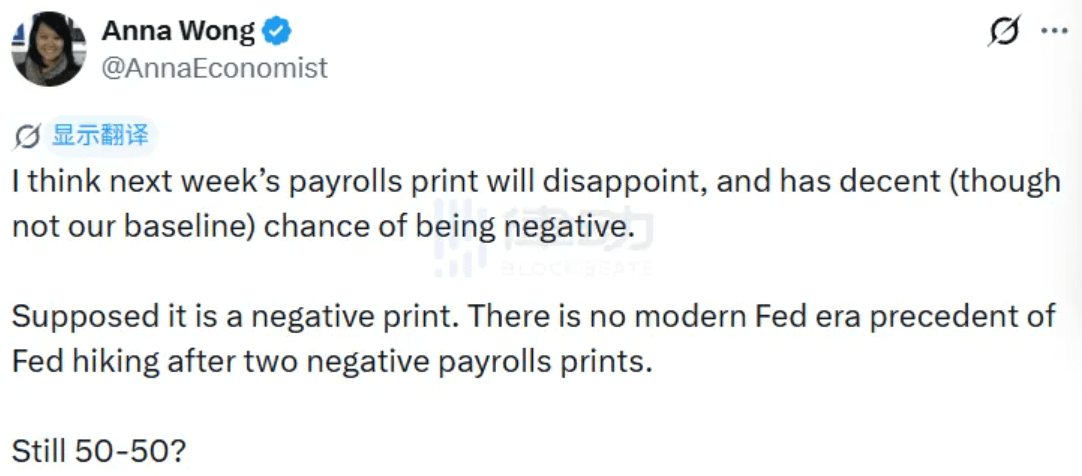
Bloomberg economist Anna Wong notes that next week’s non-farm payrolls report could come in softer than expected, potentially even showing negative payroll growth. She emphasizes that there is no modern-era precedent for a Federal Reserve rate hike after two consecutive negative payroll readings.
The argument sets up a direct contrast with remarks from Chairman Kevin Warsh at Jackson Hole, who described the labor market as consistent with full employment, pointing to a 4.1% unemployment rate and four-week average unemployment claims near the lows seen in decades.
Warsh resisted pre-committing to a policy path, insisting he is guided by discipline rather than a fixed decision or a formal reaction function.
Market reaction reflected the data-driven shift: odds of a September hike moved higher, with CME FedWatch showing roughly 42% odds compared with about 35% previously; some intraday measures flashed a swing from around 30% to near 50%.
The repricing was driven more by inflation signals and financial conditions than by payrolls. The personal consumption expenditures price index sits at 3.7% on a 12-month basis, while the six-month pace sits around 4.1%. Warsh argued that softer recent prints do not prove that the underlying trend has meaningfully improved, and he questioned whether financial conditions are truly restrictive.
Wong adds an offsetting variable: a negative payroll print ahead of the September meeting would pit hawkish inflation concerns against an employment signal that has no historical precedent for a hike. In this setup, the decision would hinge more on the intermeeting data than on forward guidance.
In the crypto and broader markets, Bitcoin dipped to about 78,700 after Warsh’s remarks, having risen roughly 9% over the week as rate-hike expectations shifted. The move came alongside softer long-end yields and a weaker dollar, supported by broader Treasury and commodity dynamics, including Brent crude trading below $90 amid an agreement affecting the Strait of Hormuz. Spot Bitcoin ETFs also saw substantial inflows, with about $2.8 billion entering across eight consecutive sessions.
On-chain data from Glassnode indicates roughly 8% of Bitcoin's supply sits between $80,000 and $82,000, and the 50-week moving average sits near $81,081, underscoring whether spot demand could absorb near-term overhead supply or if the ETF momentum could reverse first.
The overarching takeaway is that a weak payrolls print could reinforce a lower-yield backdrop, while a strong payrolls print paired with persistent inflation would uphold the hawkish stance reflected in Warsh’s commentary and the market repricing.